Rugby
Rugby is one of the most physically demanding games in terms of player injuries. Since the game has gone professional from its amateur status injuries have increased nearly 50% due to players becoming physically stronger and faster and playing with generally more determination.
With serious injuries at the rate of 1 an hour during play, it is understandable that players at all levels are now wearing padded clothing and headgear. Unfortunately this protection only reduces cuts and bruises but with the impact only reduced by no more than 5%, serious injuries are still common place.
Blood injuries tend to occur in the first half of the game, with more serious injuries in the second half, when players are tired and prone to poor tackling / ball handling skills. Flankers and the front row are the most commonly replaced forwards while wing and centre three quarters are the most vulnerable playing positions among backs.
Tackling is where 2/3rds of injuries occur, with most being to the lower limbs especially the knee, with older players more prone to injury. Upper body injuries are often caused by the player making the tackle, with dislocation and strains of the shoulder being the most prominent.
It is essential that both active players, and those that have been injured and in rehabilitation, have a well structured stretching program, that also combines regular massage / physio, to aid players in keeping fit and in shape for the game.
All match and training sessions should have a long warm-up and stretch, as every muscle will be used, normally beyond its natural limitations. Begin with the mobility exercises, this can often highlight past injuries such as poor range of motion in the shoulder joint, it is always worth having these checked by a qualified person prior to playing. The aerobic warm-up should last at least 15 minutes with simple ball passing drills utilised to aid neuro-muscular co-ordination whilst increasing blood flow to the muscles about to be stretched. Perform all of the warm-up stretches, and include the following sports specific stretches. Aim to do these stretches in un-restrictive warm clothing, keeping warm after every fourth stretch with further light jogging for 30 seconds.






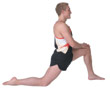
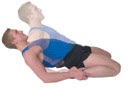

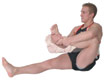






After your static stretching or team talk, look at increasing the heart rate again by performing the dynamic movements, and also the foot drills to prepare your feet and brain co-ordination.
It is wise for all players, including substitutes to stay warm throughout the game, and also to drink suitable sports based fluids to help their muscles perform correctly. All injuries however trivial should be treated at the earliest opportunity to help recovery.
As players tend to be totally exhausted in the last 10 minutes of play, the sound of the whistle tends to lead straight to the showers. Look at avoiding the rapid drop in heart rate and blood flow around the muscles, by spending what only takes 5 minutes of light jogging around the field to bring the heart rate down to a healthier level in which to stretch. Having a hot shower and removing restrictive protective clothing will aid in your post match stretch, using the cool down stretches. As you perform these stretches you will often find sore muscles in a particular area, look within this book for other suitable stretches for that area, aiming to hold all stretches for 15 seconds prior to inhaling and holding the stretch for a further 15 seconds as you exhale.