Inline Skating
Rapidly grown in popularity during recent years, in-line skating provides a good workout for your lower limbs, heart, and lungs, while placing little stress impact on your joints and muscles.
Unfortunately many injuries do occur, mainly from falls or collisions. Simple procedures will minimize these injuries, however.
Having the correct size skates is essential for both balance and comfort. When buying your skates, it's important to remember that your feet are smallest when you first awake, and largest at the end of the day, or after exercise. Ideally, you should wear two pairs of thin sport socks, both when you skate and when you purchase your boots, as this will help prevent blisters. Avoid buying boots that place pressure on any part of your foot, as this pressure will increase when you skate.
Before placing your skates on, dress yourself in protective clothing, knee and elbow pads, wrist guards, and helmet.
Spend a minimum of 5 minutes going through the mobility exercises, paying particular attention to the ankle and wrist joint.
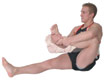
Stretching with your skates on requires your muscles to be used to aid balance, for this reason they are unable to relax and stretch sufficiently. Recreational skaters should look at spending 5 minutes or more performing the dynamic movements, after which they should do the following stretches.
 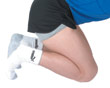 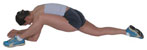 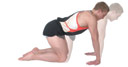  |
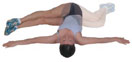 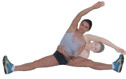 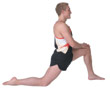 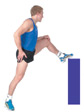 |
  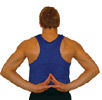  |
Learning the basic skills; such as how to stop, how to turn etc. on a smooth surface should be your first encounter wearing skate.
Advanced skaters or speed skaters should spend a minimum of 10 minutes light skating, before removing their skates and performing the dynamic movements, warm-up stretches and sports specific stretches above.Muscle strains tend to be in the inner thigh, buttocks, upper thigh, and lower back. Additional time stretching these areas both prior to, and at the end of your skating session will prevent muscle soreness.
Begin skating with small movements, gradually progressing in order to allow the muscles worked to go through the movements in a controlled manner. The reverse should be done for your cool-down, reduce your speed and also length of each movement, to help lower the heart rate, and prepare your body for the cool-down stretches. Hold each of these stretches for 15 seconds, then take a deep breathe and increase the stretch for a further 15 seconds. If you find that you are sore in particular areas, spend time stretching these muscles using the stretches available throughout this book.