Ice Hockey
Ice - Hockey is a physically demanding and often aggressive contact sport that has a number of injuries associated with it. Certain injuries can be avoided with the correct protective clothing, however the rapid twisting and turning especially of the upper body whilst trying to balance at high speed places excessive stresses on the bodies core stability area of the abdominal's, lower back and upper thigh.
Hockey injuries tend to vary according to the season of the game, with muscle strains at the beginning of the season, along with more serious injuries such as shoulder dislocations where players literally fight for their positions. As the season progresses, overuse injuries such as tendinitis and torn muscles occur due to fatigue and poor conditioning throughout the season.
Stretching and mobility exercises should be carried out throughout the season, not just on race and training days.
Begin with the mobility exercises, followed by an aerobic warm-up, ideally light jog - skipping - cycling etc, or if circumstances dictate light skating both forward and back on the ice for a minimum of 10 minutes.
Restrictive protective clothing should not be worn during the warm-up phase, as there should be no contact or any need to carry your stick. After you've finished your warm-up, come off the ice and stretch in a relaxed position wearing warm clothing. Stretching whilst on the ice or wearing skates will require your muscles to be worked in order to control your balance, because of this the muscles you're trying to stretch will often be contracted, and hence unable to stretch adequately.
Look at the warm-up stretches, followed by these sports specific stretches to prepare yourself for your final phase, which should be your drill work on the ice to bring your neuro-muscular system to optimum performance.
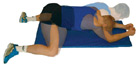
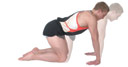
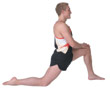
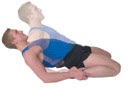










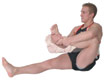
Substitutes and those in the sin bin, should aim to continually stay warm and stretch to enable themselves to be prepared for the explosive nature of the game.
Cooling down, like the warm-up should be carried out by all players by bringing the heart rate up for those that have been static on the sideline, whilst gradually bringing the heart rate down for those who have been on the ice. Stretching should again take place off the ice, with the removal of all protective clothing. Showering prior to your stretches can help, as often the protective clothing restricts blood flow whereas the hot water and hand massage will revitalise the muscles.
Look at the cool down stretches, and also perform the sports specific stretching holding each stretch for a minimum of 15 seconds before inhale and increasing the stretch as you exhale. PNF stretching for the groin - hamstrings - and shoulders should be carried out at least once a week during the match season.