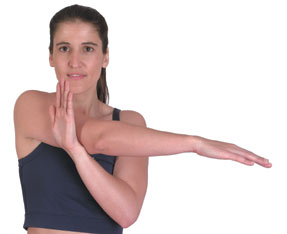
Easy Shoulder Strangle
1. Cross one arm horizontally over your chest, grasping it with either your hand or forearm, just above the elbow joint.
2. Exhale, slowly pulling your upper arm in toward your chest.
3. Aim to keep the hips and shoulders facing forward throughout the stretch. |
|
|
|
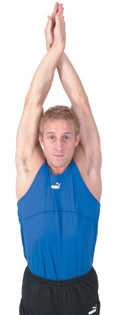
Easy Upward Stretch
1. Extend both hands straight above your head, palms touching.
2. Inhale, slowly pushing your hands upward, then backward, keeping your back straight.
3. Exhale and relaxing from the stretch before you repeat. |
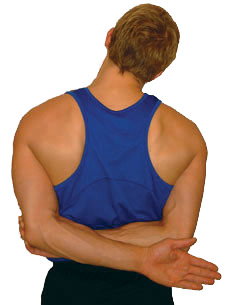
Easy-Moderate Arm Arrest
1. Extend both arms behind your back, grasping one of your elbows.
2. Exhale, slowly pulling the grasped elbow toward your spine.
3. Hold your wrist if you are unable to reach your elbow.
4. Dropping your head down toward your shoulder will also stretch your neck. |
|
|
|
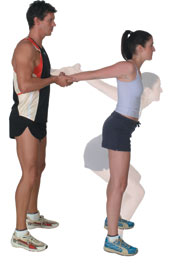
Easy-Moderate Partner Shoulder Pull
1. Stand with both your hands grasped behind you by your partner, keeping your arms straight.
2. Communicate with your partner, as you slowly lower yourself by bending your legs while your partner applies upward pressure on your arms.
3. Relax from the stretch by standing upright, and then repeat, aiming to go further down in order to develop the stretch. |
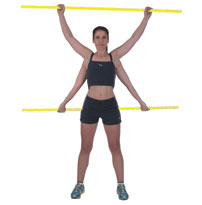
Easy-moderate Broomhandle
1. Stand with your feet shoulder-width apart, holding a bar or large towel, with your palms facing down, both hands wide.
2. Inhale, slowly aim to take both arms behind your head, resting your hands either side of your hips, palms facing behind.
3. You may find that one arm needs to bend as you twist to the side in order to perform this stretch, concentrate on avoiding this, simply work within your limits. |
|
|
|
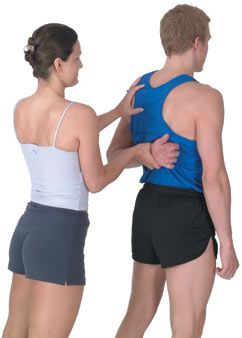
Moderate Shoulder Arm Arrest
1. Stand with one arm behind your back, palm facing outward.
2. Your partner will grasp your wrist with one hand, while the other is pressed against the shoulder blade of the bent arm.
3. Communicate with your partner as they slowly pull your bent arm upward, aiming to take your hand toward the opposite shoulder. |
Moderate Reverse Pray
1. Sit or stand with both hands behind your back, palms together, with fingers pointing upward.
2. Your partner will hold both your arms on the outside of the elbow.
3. Communicate with your partner as they slowly pull back on your elbows, keeping your palms and fingers together. |
|
|
|
Moderate Handlock With Forearms
1. Cross both arms straight out in front of you.
2. Bend the lower arm up and over the upper arm, aiming to grasp the upper palm with the fingers of your lower arm.
3. Exhale, slowly turning your forearms and wrists, so that your thumbs are facing you.
4. Increase the stretch by lowering both elbows. |
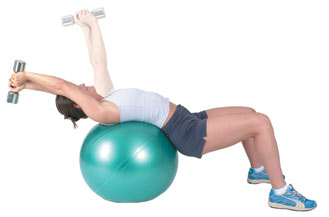
Moderate Shoulders-Swiss Ball
1. Lie on a Swiss ball or a bench, with arms straight above your head, holding a light weight to increase the stretch.
2. Inhale, slowly lowering your arms, either side of your head, keeping the arms straight.
3. Hold the stretch in the downward phase, breathing comfortably throughout, gradually lowering the weight toward the floor. |
|
|
|
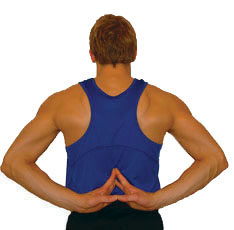
Moderate Backward Prayer
1. Stand or site with both arms behind your back, placing the tips of your thumbs and fingers together, pointing upward.
2. Inhale, slowly pushing your palms together. |
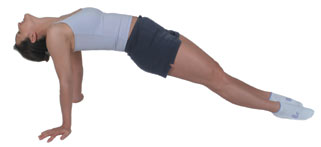
Moderate-Hard Reverse Press-Up
1. Sit on the floor, with your feet extended straight out in front of you.
2. Your hands should be behind you, palms flat on the floor, fingers pointing out to the sides, in line with your shoulders during the upward phase.
3. Inhale, lifting your buttocks off the floor, taking your head back, resting only on your hands and heels.
4. Raise your head prior to lowering yourself back down, making sure you control the movement. |
|