Mobility Stretches
Just like the engine in a car has oil to prevent the damage of metal rubbing against metal, the body has its own lubricating fluid, called synovial fluid, which helps prevent wear and tear on the joint surfaces from bones rubbing against each other.
When we first awake, this synovial fluid has drained back into its own reservoir around the joint (synovial membrane)-just like the oil within the car engine, which sinks to the bottom. When we wake up, or become active after long periods of inactivity, e.g. a plane flight, we should perform the following sequence to help “lubricate” the body.
The sequence of movements involved for mobility is similar to those that are performed throughout your normal day, so, if time is a major factor, you may wish to begin with your warm-up, which will also aid in lubricating your joints.
Once you are confident with each individual mobility exercise, you may wish to combine the exercises into your own routine, for example, working the fingers, wrists, and elbows all at the same time.
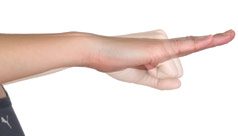 |
(1) Fingers and Knuckles -
Simply clench your fist and flick out your fingers, slowly at first (the complete action should take 3 seconds), then gradually increasing the speed so that you are clenching and flicking your fingers twice in a single second. Perform this action for 10 seconds, working both hands at the same time. |
|
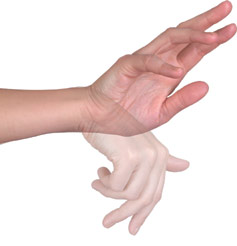
(2) Wrists -
Rotate your wrists first clockwise and then counter-clockwise, in a slow, controlled motion, followed by simple flexion and extension of the wrists, with your fingers pointing straight out. |
 |
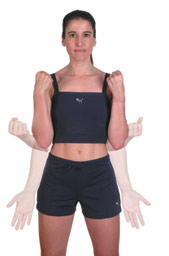 |
(3) Elbows
- Begin with controlled flexion and extension of the arm, bending at the elbow joint, with your arms tucked into your side. As you perform this action, turn the palms of your hands first toward and then away from the body, in order to create a slight twisting action at the elbow joint. |
|
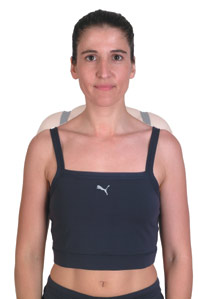
(4) Shoulders
- Raise the shoulders slowly upward toward your ears, in small movements, allowing your shoulders to relax downward naturally. Breathe in through your nose as you raise the shoulders, exhaling the air from your lungs in the downward phase. Gradually make the movements larger; and then switch to a circular motion of the shoulder joint, taking the shoulder in both backward and then forward circles. You may want to work the shoulders both together, or each shoulder separately. Whichever you choose, aim to work for a minimum of 30 seconds on each side, as your shoulders are generally the first area of the body to suffer when you are under any stress. |
 |
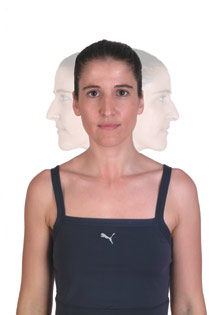 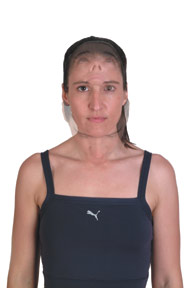 |
(5) Neck
- Aim to look over one shoulder then slowly turn your head to look over the other shoulder in an over-emphasized “No” motion. Repeat this 5-10 times each side, taking 2 seconds for each movement. After the “No” movement, perform a “Yes”, nodding action, taking your head downward first then upward again, repeating 5-10 times with 2 seconds for each movement either up or down. Next, gently side-bend the head, i.e., tilt your head toward your shoulders. Do not force this movement-as you start, gently let your head relax down toward your shoulder. Repeat 5 times each side, making each movement last 5 seconds. (Note: stop immediately if you experience any feeling of dizziness, and do not repeat.) You can finish by rotating the head in a clockwise and counter-clockwise motion. Focus on simulating a spiral effect, starting with small movements, working out to gradually larger movements, and keeping the action under control at all times. Spend only a short time doing this exercise, as it can irritate the tiny neck joints, and think about keeping your neck “long” throughout (therefore avoiding taking your head back too far). If you have a very stiff or sore neck, it is best to avoid this exercise altogether. |
|
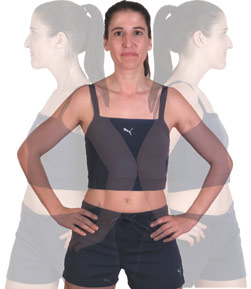
(6) Trunk / Waist
- Keeping your hands on your waist, make small twisting movements from your waist to take one elbow forward and the other one back. Follow this by sliding each hand downward on your leg toward your knees. Throughout both actions you should be standing with your feet a shoulder-width apart and your pelvis facing forward. Keep the motion under control, and avoid swinging or bouncing-remember that you are only warming up the joints, the movements should be no more than 2 inches to either the front or side. |
 |
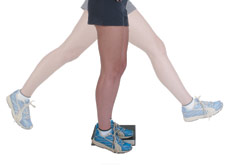  |
(7) Hips
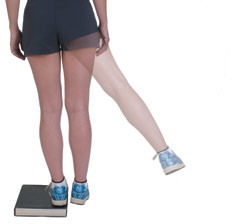
- Dependent upon your balance, you may want to hold onto a chair for support. In a controlled motion, extend one leg forward, then directly behind, in small movements keeping the leg straight. Repeat 3-5 times. Placing your other leg on a raised platform will enable you to perform these routines without the foot of the working leg making contact with the floor. Take the same leg out to the side of the body (this is called “abduction”), again in small movements. Repeat 3-5 times. Finally, perform small circular motions with the leg, taking the leg from the center outward, first in a forward and then in a backward direction, and always controlling the movement of the leg. After you have performed these three simple movements you can repeat the complete process again, but this time make the movements slightly larger. If you find that standing on the same leg is uncomfortable, you should change legs frequently, ideally before any discomfort is felt. You may find it more comfortable having a slight bend (soft knees) in the leg you are not working. |
|
(8) Knees
-Again holding onto a chair for support, if you choose, flex the leg to bring your foot behind you. Repeat this action on both legs 10-15 times, in a smooth, controlled motion. Follow this action on both legs by performing a circular motion of the foot from the knee joint in both clockwise and counter-clockwise directions, 5-10 times. You may find it easier to perform this and the ankle and toe exercises while seated on a suitable chair. |
 |
|
(9) Ankles / Toes
- Perform the same sequence for the ankles as for the wrist, using circular motions in both directions, followed by flexion and extension of the foot. After this, place your heels on the ground and raise your toes off the floor. Concentrate on curling up and relaxing your toes. It is best to carry out these exercises without wearing any footwear. |