Walking
Walking reduces blood pressure, lowers the levels of " bad LDL " cholesterol in your blood tones up your muscles and strengthens your bones. An excellent form of exercise for persons who wish to lose weight, or simple improve their fitness level through low impact and low intensity exercise.
Requiring only simple equipment, and being able to be performed by almost anyone anywhere and at any time, walking should be promoted more for good health.
How to walk. (Briskly)
A 90-degree bend in your arm makes your arms a shorter pendulum, so they can swing faster as your step speeds up. At normal speed allow your arms to swing freely and rhythmically, remembering that your arm speed controls your leg speed.
Quicker, smaller steps will cover more ground, then long strides, which tire your muscles. Resist the temptation to lengthen your stride to go faster.
Strike the floor with the heel of your shoe, roll onto the ball of your foot and aim to push off with your toes. Avoid bending over, looking down on the floor, stay tall with your head up, checking for obstacles that are in your path.
When walking uphill, take smaller strides, leaning into the hill, if the hill is really steep, traverse (zigzag) up it to make it easier on your legs. Control your breathing, take full breaths and exhale completely.
Your Clothes
It is important that your clothes are both comfortable and practical. Prepare to dress for any weather, wearing clean clothing will enable the fibres to both keep your warm and also take the sweat away from your body; matted fibres will not do this.
Wearing layers will enable you to both keep warm, as the air is trapped between the layers of clothing, and also let you take layers off as you start to get warm.
Aim to carry a waterproof jacket and hat in case the weather turns cold and wet, or if you meet another walker who may have had an injury, and needs to stay warm.
Walking Shoes
Avoid going for looks; go for comfort when choosing your walking shoes. Training shoes with a laced fit, with rubber soles offer good support for general walking on firm ground. If walking over uneven hilly ground a hiking boot with more support is recommended.
When purchasing your shoes, wear your socks, sports socks for trainers, or two thin pairs / one thick pair for hiking boots, cotton / wool non-tight socks will allow your feet to breathe. There are many good designs from fitness walking shoes through hiking boots. You will want more flex in an athletic shoe, more support in a hiking shoe.
When choosing hiking boots, you should be able to twist them a bit (torsion flexibility). They need more of a bend than a running shoe - in the forefoot, not the arch, in order to keep the front of the boot slightly off the ground.
Inside the boot, you should have good arch support, and a correct fitting, if they feel tight, go up a size, as your feet will expand when hot and under pressure.
Boots should have a good pattern on the sole, with at least 1/2 inch of rubber to give both cushioning and grip. The rest of the boot should be made of strong leather or breathable nylon with good water proofing capabilities.
Injuries associated with walking are generally caused by falls or trips, the use of specialist walking poles, or even a sturdy stick will help give you balance and extra leverage on steep climbs.
Prepare for your walks by performing the mobility exercises. After 5-10 minutes light walking carry out all the warm-up stretches. If you are short of time, i.e. having a walk in your lunch break, carry out the quick stretches, again after 5 minutes of steady walking.
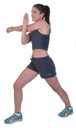
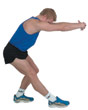

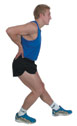
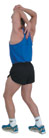
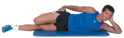
At the end of your walk, carry out the cool down stretches. Concentrate on areas that may feel stiff, your calf's - quadriceps (front thigh) - lower back and triceps (back of arms).
Items to carry with you.
If simply walking to work, don't forget your brief case and lunch.
Fluid if going on long walks, hot in a flask if weather is cold.
A whistle if walking in woods, or areas where you may get lost, blow for 6 loud blasts if lost, likewise if you hear, reply with 3 loud blasts back.
Snacks, if you are walking for more than an hour, keep your blood sugar up with healthy snacks, such as apples.
First Aid kit, containing plasters and if possible blister treatment kits.
Strong stick, useful for giving support whilst walking, and also in need of protection.
Money, always handy for a thousand and one uses.
Sun cream and sun glasses if the weather is nice.