Horse Riding
Horse riding either recreational or equestrian carries a higher injury rate than that of motorcyclists, with more than 2,300 riders under the age of 25 hospitalised in the USA. On average, motorcyclists suffer an injury once every 7000 hours of riding, whilst an equestrian (horseback rider) may have a serious accident once every 350 hours.
Injuries are often the result of a fall, and commonly occur in the upper extremities, such as the wrist, elbow, and shoulder. Lower extremity injuries, involving the knee, ankle, and feet are more frequent in rodeos due to the rapid turning movements.
Correct protective clothing for both the horse and rider is essential to reduce the risk of injury, likewise great respect needs to be given whilst amongst horses, with parents explaining the dangers to their children, at the same time, keeping a close eye on them.
Horse riding, especially for those new to this experience will often give rise to feeling sore between the inner thigh, upper quadriceps and lower back, due to these muscles being worked often in an isometric (static) mode, in order to minimise excessive movement whilst mounted on the horse.
Isometric exercise places considerable strain on the muscles, and as such new or irregular riders should aim to progress slowly the amount of time they spend in the seat according to their own body condition. There is nothing wrong with riding for say twenty minutes, then having a short break to stretch out before riding for a further 20 minutes.
Carry out the mobilisation exercises prior to going into your warm-up phase. Your warm-up could involve the daily chores undertaken at most stables, i.e. mucking out, filling water buckets etc, anything that will raise your heart rate slightly to enable the muscles to get warm through blood flow.
Once warm, look at doing all of the warm-up stretches, as you will find that horse riding will place a strain on muscles that you didn't know existed. After giving your complete body a good stretch, use the following stretches prior to mounting and descending your horse to reduce muscle stiffness in prominent riding muscles. Always remember to stretch in a safe area, with warmed muscles. The warm-up should also consist of gentle riding to allow the muscles to become accustomed to the movements for both horse and rider for a minimum of 5 minutes.


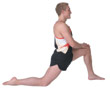

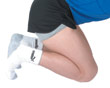

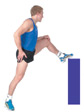

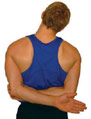

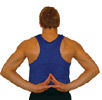
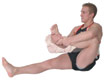
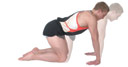

Remember that tired muscles become tight and such lose their flexibility, which often results in poor riding position. Likewise your horse when tired will become more prone to injury and have an unbalanced stride, increasing the risk of injury to both horse and rider.
Your cool down should consist of light riding for 5 minutes before performing the mounting and descending stretches as soon as possible. After you have administered your horse, spend more time stretching out, once again the descending stretches and then the cool down stretches. Hold each stretch for 15 seconds then inhale, gradually increasing the stretch as you breathe out slowly.