Shoulder Anatomy
The shoulder joint is the most versatile joint in the human body, having eight major movements.
Abduction – horizontal upward movement of humerus away from midline or return from adduction – (lifting the arm out to your side).
Adduction – taking the arm across the body.
Flexion – forward upward movement of the arm.
Extension – backward upward movement of the arm.
Inward / medial rotation – rotating the arm inwards.
Outward / lateral rotation – rotating the arm outwards.
Horizontal flexion – taking the arm from a horizontal side position to a front horizontal position.
Horizontal extension – taking the arm from a horizontal front or side position to a side or rear horizontal position.
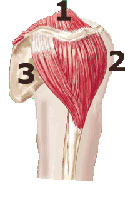 There are a number of different muscles associated with the shoulder joint in order to enable the vast array of movements to take place.
The main muscle is the deltoid 2, which originates along your clavicle (collar bone 1) and scapula (shoulder blade 3). The muscle inserts onto the outer side of the upper arm, about half way down the bone.
The muscle has a combination of anterior and posterior fibres, the anterior fibres aid in flexion - medial rotation and horizontal flexion of the arm. The posterior fibres aid in extension - lateral rotation and horizontal extension of the arm.