Why Stretch
Stretching should become a regular routine for everyone, not just for professional athletes who already understand the benefits associated with performing a sequence of stretches.
Some of these benefits are physically apparent, such as a greater range of movement; while others can’t be seen, but are felt from within, such as an increased feeling of relaxation and general well being.
Stretching is not like going on a diet, where you may find yourself feeling bad for a while because you are restricted to certain foods. Once your target weight is reached, you then stop your diet and, for many, begin the negative phase again, eating the same foods that made you overweight in the first place. Stretching, once done properly, can become an unobtrusive and enjoyable part of your daily routine, which you will find yourself doing naturally, and reaping the benefits permanently. It can become a new way of life for many people-just look at the recent boom in Yoga and Pilates classes, which are based upon correct breathing, and stretching, and alignment. Numerous celebrities have recognized the positive effects of stretching, along with the “feel good factor”, and have seen the benefits in helping them cope with their stressful lifestyles. Some have even gone on to promote the techniques in their own exercise videos.
Once you can see and feel the benefits of something, it is much easier to stay motivated and to continue with it.
Resting Heart Rate
The best time to take your heart rate is when you first wake up in the morning, as this is when your body is at rest. If you can take recordings over three days to find an average, you will get a more accurate reading. For example, readings taken on three consecutive mornings might be 75 BPM (beats per minute), 72 BPM, and 72 BPM. The average is then calculated by taking the total number of beats and dividing it by the number of mornings tested.
Answer: 75 + 72 + 72 = 219 219 ÷ 3 = 73 BPM
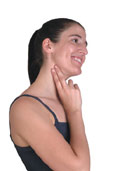
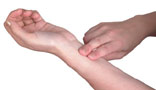 To take your heart rate, place two fingers on either your wrist (radial artery), or neck (carotid artery). Avoiding pressing too hard, count the number of beats during a minute.
Perform this simple test over the next three days, and then after one month, three months, and six months.
|
DATE
|
DAY 1
|
DAY 2
|
DAY 3
|
AVERAGE
|
| START | . | . | . | . |
| 3 MONTH | . | . | . | . |
| 6 MONTH | . | . | . | . |
| 9 MONTH | . | . | . | . |
| 12 MONTH | . | . | . | . |
Body Awareness
Stretching enables you to become more aware of your body’s proprioception, i.e., having an internal awareness of any part of your body.
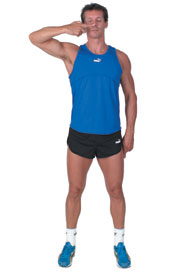
Try this simple test, first using the index finger of your writing hand, then the index of your weaker hand. With your eyes closed, choose a number of precise points around your body, and aim to slowly place the index finger onto each point in turn. Score the test yourself by putting a tick in the box if you place your finger onto the body point, or a cross if you miss.
NB: Avoid choosing the eyes as one of these points (in case you poke yourself in the eye by mistake), and don’t select moles, scars, or tattoos, as these will have no sensory paths to them, and as such you will be working purely on memory.
|
BODY PART
|
LEFT
|
RIGHT
|
| LEFT EAR | . | . |
| RIGHT EAR | . | . |
| OPPOSITE THUMB | . | . |
| OPPOSITE LITTLE FINGER | . | . |
| LEFT ANKLE | . | . |
| RIGHT ANKLE | . | . |
| NOSE | . | . |
| BELLY BUTTON | . | . |
Flexibility Test
The hamstring muscles (located at the back of the upper leg) are tight in most people, especially men and football players.
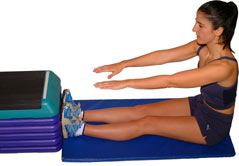 While sitting on the floor, shoes removed, place the soles of your feet flat against a wall and aim to take your fingers toward the wall. Do not “bounce”, or force your body into the stretch, but make sure that the movement is controlled and pain-free.
Aim to keep your back straight, bending at the lower back/waist, keeping your legs straight and in contact with the floor. Focus on trying to touch the wall with the tips of your fingers. You may need to do this test with a partner, so that they can use a ruler to measure how far away you are from the wall.
If you can touch the wall comfortably with your fingers, then you may want to try sliding your fingers along a coffee table, again keeping the legs and back straight, and, for accurate progression results, aim to use the same table each time you try this test.
The distance you measure will be either be the distance away from the wall in the first method, or the distance over the end of the table in the second method. You may even wish to measure your flexability both before and after your stretching routine, so you can see your increase in flexability.
|
DATE
|
WALL
|
TABLE
|
WALL
|
TABLE
|
| START | . | . | . | . |
| 3 MONTH | . | . | . | . |
| 6 MONTH | . | . | . | . |
| 9 MONTH | . | . | . | . |
| 12 MONTH | . | . | . | . |
Why Warm Up?
Imagine your muscles to be like a piece of clay. When you first pick up the clay it is dry, hard, and non-pliable. You can aim to bend it into the shape you want, but will soon find that it splits and eventually breaks in two. After adding a little water, and some warmth from rolling the clay in your hands, the same non-pliable piece of clay quickly becomes soft and pliable and you are able to mold it into a whole array of shapes.
The same can be said for your muscles: when cold they can be stretched, but muscle receptors restrict you from over-stretching them, and in turn prevent muscle damage. Basically, this means that you cannot achieve a full stretch when a muscle is cold, and equates to insufficient muscle stretch, especially if you are aiming to place high levels of stress upon the muscle, i.e., when you are about to exercise.
As with clay, in order to achieve a greater level of stretch within the muscle, aim to spend time warming up,. A gradual increase in the heart rate will enable the warmth of the blood, passing more and more rapidly through the muscle, to steadily improve the muscle’s pliability.
Look upon your warm-up as a sequence of logical events that will aim to give you the following benefits:
A reduced risk of injury to the joints, muscles, and tendons.
A reduction in muscular soreness and tension.
An increase in heart rate, blood flow, body temperature, nerve impulses, metabolic rate, and oxygen utilization.
Greater body awareness and mental alertness.
Improved range of motion and enhanced physical ability.
Sport specific stretching and focusing on the task ahead.