Warm Up
The warm-up is one of the key elements to a successful stretching program, and, as such, you should allocate an adequate amount of time within your workout or stretching routine to enable your muscles to become adequately warm. Muscles can only achieve maximum performance when all their blood vessels are dilated, enabling sufficient blood flow. At rest, muscles only utilize 15-20 percent of blood flow, compared to 70 percent, or more, after only 10 minutes of activity.
The warm-up can be both passive, using an outside influence such as hot shower, bath, heat lamp, massage, extra clothing, sauna and so on. Alternatively, it can be active, using body movement to generate warmth. During the active phase, athletes should aim to concentrate on imitating the movements that they will be performing when in full flow, for example, controlled punching prior to actually boxing or taking a Boxercise class.
Runners tend to stretch their cold muscles before going for a run, and as such have little or not benefit the time they spend stretching. Greater results would be achieved if stretching were carried out after 10 minutes fast walking/slow jogging.
Because the passive method works on warming up the superficial out layer of the body (i.e., the skin), we actually get the feeling of warmth. This method is not as effective as an active warm-up, because, with the exception of massage, there is no major increase in the blood flow through the muscles, and, as such, is only really suitable as a pre-active warm-up.
The best way to warm up is to combine both methods, where possible. If you are looking at just performing a stretching program, consider spending times in a warm bath first, to help raise your body temperature. When you come out of the bath, dress in warm clothing that is suitable for you to perform the stretches without restrictions.
After your bath, spend a minimum of 5 minutes performing active movements prior to any actual stretching.
Using the larger muscle groups, such as the quadriceps (upper thigh) and the gluteal (buttock) muscles, is the most effective way to relocating your warming blood from areas such as the digestive to the muscles.
A very simple active warm-up can consist of the following routine. You may already have your own routine or suitable aerobic video that you prefer to use. Alternatively you may wish to perform the dynamic warm-up movements in a very gradual method, increasing the range of movement as you feel your body warm-up.
|
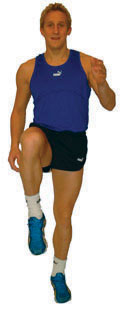
(1) March on the spot, gradually taking your knees a little higher, while at the same time working your arms, doing the finger, wrist, and elbow mobility exercises. 2 minutes. |
 |
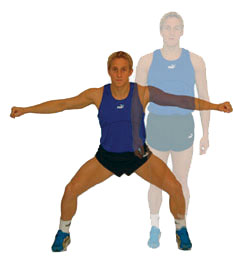
| (2) Follow this by taking one leg to the side, alternately, while raising both your arms out to the side (no higher that shoulder level). 1 minute. |
 |
|
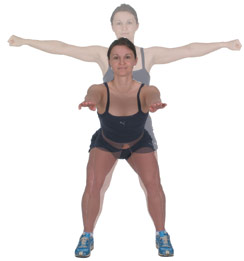
(3) Do some simple squats-holding your arms at just below shoulder level, take your hands to the front as you squat down, and then your arms to the side as you come up to a standing position. 30 seconds. |
 |
|
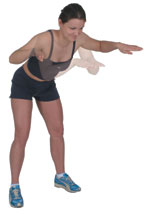
(4) Simulate a swimming action, arms only-front crawl, backstroke, butterfly, breaststroke. 15 seconds each movement. |
|
Repeat the above once more, or until you feel warm.
The length of time you spend warming up will vary depending upon your age, fitness level, and the room temperature. By now you should generally be developing a light sweat, a feeling of general looseness, and a greater range of mobility prior to going into the stretch phase.
You need to stay warm throughout your stretching, so you should quickly dry any sweat away. Ideally your hair should not be wet from your shower or bath. If possible, the room temperature should be increased slightly, or an extra layer of non-restricting clothing worn. If you start to feel cold, or your range of movement throughout the stretch is not what you normally perform, warm up the body again, and then continue with your stretching.