Muscle Anatomy
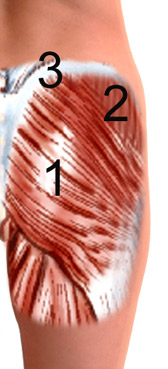
The buttock has a number of muscles, mainly the large gluteus maximus (1), with two smaller glut muscles underneath, namely the gluteus minimus and gluteus medius (2).
 The
gluteus maximus originates on crest of the ilium (inner top of your pelvis)
and along the surface of your sacrum (lower spine).
The
gluteus maximus originates on crest of the ilium (inner top of your pelvis)
and along the surface of your sacrum (lower spine).
This large muscle inserts onto the top of the thigh bone (femur) and joins the iliotibial band, (long tendon muscle at the outer side of the upper leg).
Its main function is to extend the hip (bring the leg back), laterally rotate the hip, with the lower fibres assisting in adduction (bring inwards) of the hip.
The gluteus medius originates at the top of your pelvis, just below your crest (3), and inserts onto the outer side of your top portion of your thigh bone, with its main function being abduction of the hip (taking leg out to the side).
The gluteus minimus
originates just below the origin of the gluteus medius, and inserts at the
top outer portion of your thigh bone, with its main function being abduction
of the hip, and medial rotation (turn the leg inwards) whilst the leg is out
to the side - abduction.
Underneath the main glut muscles lie a number of smaller muscles, the main
known one being the piriformis, whose main function is to laterally rotate
the hip.
These 6 deep lateral rotators originate on the sacrum (lower spine) and post portions of the ischium (lower pelvis) the part you sit on. They all insert onto the inside of the thigh bone (femor), at the top portion of the bone which is called the greater trochanter.
There main action is lateral rotation of the hip, turning the leg outwards.