Biceps Muscle Anatomy
 The
Biceps and Triceps make up the main muscles of the upper-arm, with the Triceps
(the muscle at the rear) making up approximately 2/3rds of the upper arm mass.
The
Biceps and Triceps make up the main muscles of the upper-arm, with the Triceps
(the muscle at the rear) making up approximately 2/3rds of the upper arm mass.
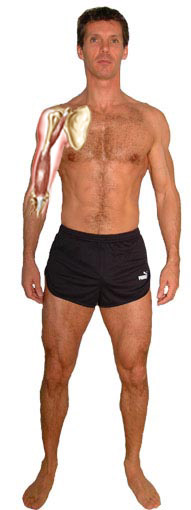
The Biceps originate on an area in the Scapula or shoulder blade, near the shoulder joint, and go down to attach below the elbow on one of the two forearm bones called the Radius, (insertion on tuberosity of radius).
The Biceps get there name because there are two heads, hence bi. The long head originates at the top of the glenoid fossae, whilst the short head originates at the coracoid process.
The primary function of the Biceps muscle is to move the forearm towards the shoulder (elbow flexion). This movement is assisted by two other muscles, Brachialis and Brachio-Radialis.
The secondary function
of the Biceps is supination of the forearm. This means turning the hand from
a palms-down position to a palms-up position, as in turning a fork to put
food in your mouth.
The Brachialis muscle originates at the lowe half of the upper arm (humerous), and inserts onto the other forearm bone called the Ulna at the Caronoid Process, its action is true flexion of the elbow joint.
Brachio-Radialis aids in the flexion of your elbow and the rotation of your lower arm from a palms down (pronation) position to palms up (supination) and vice-versa.