Back Muscle Anatomy
The back contains a complex network of muscles, nerves and the vertebral column. The spinal column contains 24 articulating (joined but move together) moveable vertebrae, and a further 9 where the bones are fused together ( sacrum and coccyx ) where no recognizable movement occurs.
The
spinal muscles basically consist of two layers, deep and superficial.
The deep muscles work to move the joints on an individual level, predominately
rotation and side bending, also they act as strong supporters of the spinal
column as a whole. The superficial work in groups over a span several
vertebra at a time, to perform the more stronger movements of extension
and side bending, and help to co-ordinate the muscles working the limbs
on the trunk.
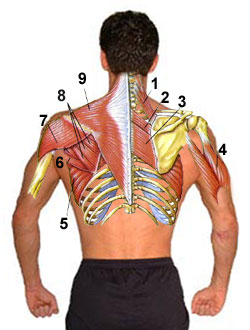 1
Levator Scapulae - elevation of the scapula (shoulder blade).
1
Levator Scapulae - elevation of the scapula (shoulder blade).
2 - 3 Rhomboids Minor and Major - slight elevation of the scapula towards the spine, bring the scapula towards the spine.
4 Triceps - Not a back muscle, however often used in back exercises during the lowering or lifting phase.
5 Serratus Anterior - takes the scapula away from the spine.
6 Teres Major and Minor - bring the arm back in towards the body, as well as rotating the arm outwards.
7 Deltoid (Posterior) - takes your arm out to the side, with your posterior (rear) deltoid rotating the arm outwards.
8 Infraspinatus - assists in rotating the arm outwards.
9 Trapezius - Upper fibres lift the scapula - Middle fibres lift and pull the scapula towards the spine - Lower fibres pull the scapula downwards towards the spine.
The above are the main muscles of the upper back, however two other muscles should be mentioned, which are not shown on the above diagram.
1 Erector Spinae - This muscle is a complex group of smaller muscles that run the complete length of the spine from your sacrum and crest of your ilium (where your back bone meets your pelvis) all the way to the base of your skull. They aid to extend the spine (lean backwards) and lateral flexion, (bend to the side).
2 Latissimus Dorsi - An extremely powerful muscle of the lower back, which originates from your sacrum and top of your inner pelvis, along your lumbar spine and lower six thoracic vertebrae, as well as the lower three ribs. It inserts on the inside of the upper arm, with its main function being that of bringing your arms down from an elevated position - (exercises such as pull-ups).